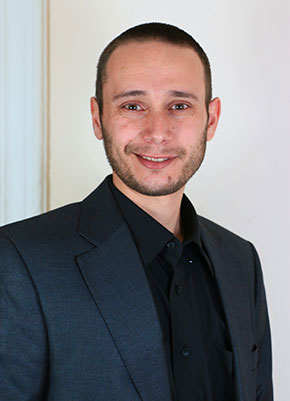
How I became a teacher
My interest in English began while I was still at school. I was a good student, including in English, but in the 1990s English lessons were rather formal and my actual command of the language was still quite limited.
Everything changed when an American Peace Corps volunteer came to our town and started a free English conversation club. I began attending regularly, and through constant communication with foreign teachers English gradually became part of my everyday life.
We spent a great deal of time together outside the classroom as well: playing sports, hiking and going fishing. Several years of this kind of real-life communication transformed my English.
Eventually I began helping with the conversation club and sometimes conducted sessions myself. That was when I first realised that I enjoyed not only the English language, but teaching it as well.
Professional education
In 2001, I entered the Faculty of English Philology at the Uzbekistan State World Languages University.
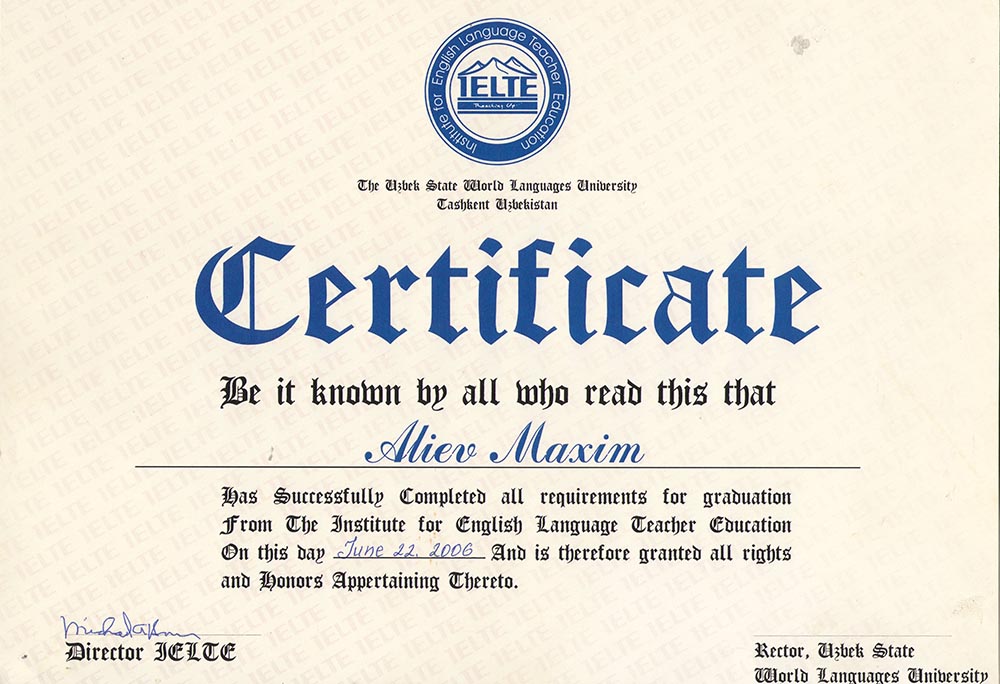
That same year, I passed the competitive selection process for the IELTE — Institute for English Language Teachers Education programme and studied there throughout all four years of my bachelor's degree.
What made IELTE different was its focus on training us specifically as English language teachers. We studied teaching methodology, educational psychology, approaches to teaching children and adults, working with mixed-level groups and a wide range of classroom situations.
I began teaching while I was still at university. During my third and fourth years, I taught English literature to junior students, and in my fourth year I also taught General English at a language centre.
In 2005, I completed my bachelor's degree and continued with a master's programme in English Linguistics at the same university.
At the same time, I worked as an English teacher at the Institute of Oriental Studies, where I taught General English.
Professional background
After several years of teaching, I briefly moved into a different field and worked as a translator and assistant to the director of an international company.
This experience gave me a chance to see how English is used in a real business environment. It was also during this period that I realised that teaching was the work I genuinely wanted to do.
After returning to education, I taught General English, IELTS and Business English, working both individually and with corporate groups.
During this period, I spent about six months teaching English individually to the director of LUKOIL in Uzbekistan, while also conducting group lessons for company employees.
From 2010 to 2012, I worked as an English teacher on preparatory programmes at MDIS in Tashkent, teaching General English and Academic English and preparing students for university admission.
Since 2012, my main professional focus has been private English teaching.
Private teaching practice
Over the years, I have worked with students of very different ages and with very different goals.
A significant part of my work is preparing teenagers and university applicants for IELTS, as well as TOEFL, CEFR, SAT and university entrance examinations.
At the same time, I have always worked with many adult learners: doctors, engineers, entrepreneurs, company executives, pilots, cabin crew and professionals from many other fields.
Some needed English for their careers, others for relocation and continuing their professional lives abroad, communication with international partners, professional examinations, job interviews or further education.
I also have extensive experience in corporate English training . Over the years, I have taught employees of Perfectum, AKFA, Agromir, the Institute of Geology and other organisations.
I work in different formats: individual lessons, lessons in pairs and corporate groups.
My approach to teaching
The main principle behind my teaching is simple: there is no single programme that works equally well for everyone.
Every student has different goals, strengths and weaknesses, personality, learning pace and level of motivation. The programme therefore has to be built around the individual student.
I usually use a structured course as a foundation and add materials according to what the student needs most: grammar, vocabulary, reading, writing, speaking or other skills.
The pace and workload are also individual. If someone is learning English for personal development or an exam is still a long way off, there is no reason to rush the process. If an important exam is only a few months away and there is a lot of work to complete, the training naturally becomes much more intensive.
At the same time, it is important not to cross the point where workload begins to reduce interest and motivation.
For me, being a good teacher therefore means more than knowing English and understanding teaching methodology. A teacher must be able to understand the student, identify weaknesses, take personality into account and find the approach that helps that particular person move forward.
What matters most to me
The most important thing for me in teaching is the result.
I look at progress as a whole: test and exam scores, practical language ability and how close the student is getting to the goal that brought them to English in the first place.
One of the most important moments comes when students begin to feel their own progress. They notice that they understand more, speak with greater confidence and can do things that previously seemed difficult.
That is when genuine internal motivation begins to develop.
I see learning as a partnership between teacher and student. My role is to understand what is holding the student back, choose the right direction, provide support and, when necessary, be demanding.
But without the student's own willingness to learn, meaningful progress is unlikely. If a student genuinely does not want to study and the lessons are entirely the parents' decision, I would rather end the lessons honestly than continue simply for the sake of payment.
Professional development
I believe that a good teacher must continue learning as well.
I regularly explore new teaching materials, books and courses, read about language teaching and methodology, and keep up with new approaches to English language education.
For me, professional ability is not measured by the number of certificates a teacher has, but by how well that knowledge can be applied in practice and how effectively it helps students achieve their goals.